Affiliate Tracking Software for Amazon Sellers
Category: Affiliate tracking software
Think of affiliate tracking software as your brand's dedicated partnership manager. It’s the system that monitors, measures, and rewards the creators, influencers, and bloggers who are successfully sending customers to your Amazon listings. Instead of throwing marketing dollars at the wall and hoping something sticks, you get to see exactly who drove which sale.
Unlocking Your Brand's Hidden Sales Force
Imagine you've just hired a team of salespeople who work remotely. How would you track their performance to know who deserves a commission? Trying to do it all with a spreadsheet would be a complete mess—a chaotic, error-prone headache. That's the exact problem affiliate tracking software solves for your Amazon brand, just in the digital world.

This software acts as the central hub for your entire partner marketing program. It forges an automated, seamless link between an affiliate's content—say, a YouTube review or a blog post—and a customer making a purchase on your Amazon page. It all works through unique tracking links that act like digital fingerprints, making sure every single referral gets credited to the right partner, every time.
The Power of Precise Measurement
Without a proper system, affiliate marketing feels like pure guesswork. You might see a bump in sales, but you'd have no clue which influencer's video or which specific article actually moved the needle. This is a recipe for wasted ad spend and missed opportunities to double down on what's working. Affiliate tracking software takes the uncertainty out of the equation with clear, data-backed insights.
This isn't some niche tool anymore; it's a core part of any serious e-commerce strategy. You can see this shift in the market's growth. In 2024, the affiliate tracking platform market was valued at $3.86 billion, and it’s on track to hit $6.53 billion by 2029. That incredible growth shows just how many brands are ditching manual methods for more powerful, automated solutions.
From Manual Mess to Automated Success
For any Amazon seller who is serious about scaling, trying to manage partners with spreadsheets just isn't sustainable. A simple spreadsheet just can't keep up. It can't:
- Show you real-time sales data: You’re always looking at old news.
- Manage complex commission rules: Forget about setting different rates for top partners or specific products.
- Catch fraud or accidental double payouts: You could easily end up paying for the same sale twice.
- Build trust with your affiliates: Partners want to see their performance and earnings in a transparent dashboard, not wait for your manual report.
At its heart, affiliate tracking software creates a single source of truth. It guarantees every affiliate is paid fairly and accurately for the sales they generate, which is the key to building profitable, long-term relationships.
Ultimately, this software is the foundation you need to build a scalable partnership program. It’s how you define the way sales are attributed to different marketing efforts. If you want to dive deeper into this, our guide on https://coral.ax/blog/what-is-attribution-modeling breaks down the different ways you can assign credit for conversions. And as you get started, it's smart to understand the ground rules by reviewing typical affiliate program terms and conditions. By letting the software handle the technical heavy lifting, you're free to focus on what really matters: building great relationships with partners who genuinely love and promote your brand.
Essential Features Every Amazon Seller Needs
Picking the right affiliate tracking software can feel overwhelming, especially when you're playing by Amazon's unique set of rules. Let's be honest, not all platforms are built the same, and a generic solution just won't cut it. To really build a partner program that scales, you need tools designed for the specific challenges and opportunities you face as an Amazon seller.
Think of it like this: you wouldn't use a regular city map to navigate the open ocean. You need specialized charts. In the same way, your software needs features that understand the currents of Amazon’s ecosystem. The right tools turn a flood of raw data into a clear roadmap for growth, showing you exactly what’s working and where to put your money for the best results.
The infographic below breaks down the core pillars of an effective platform.
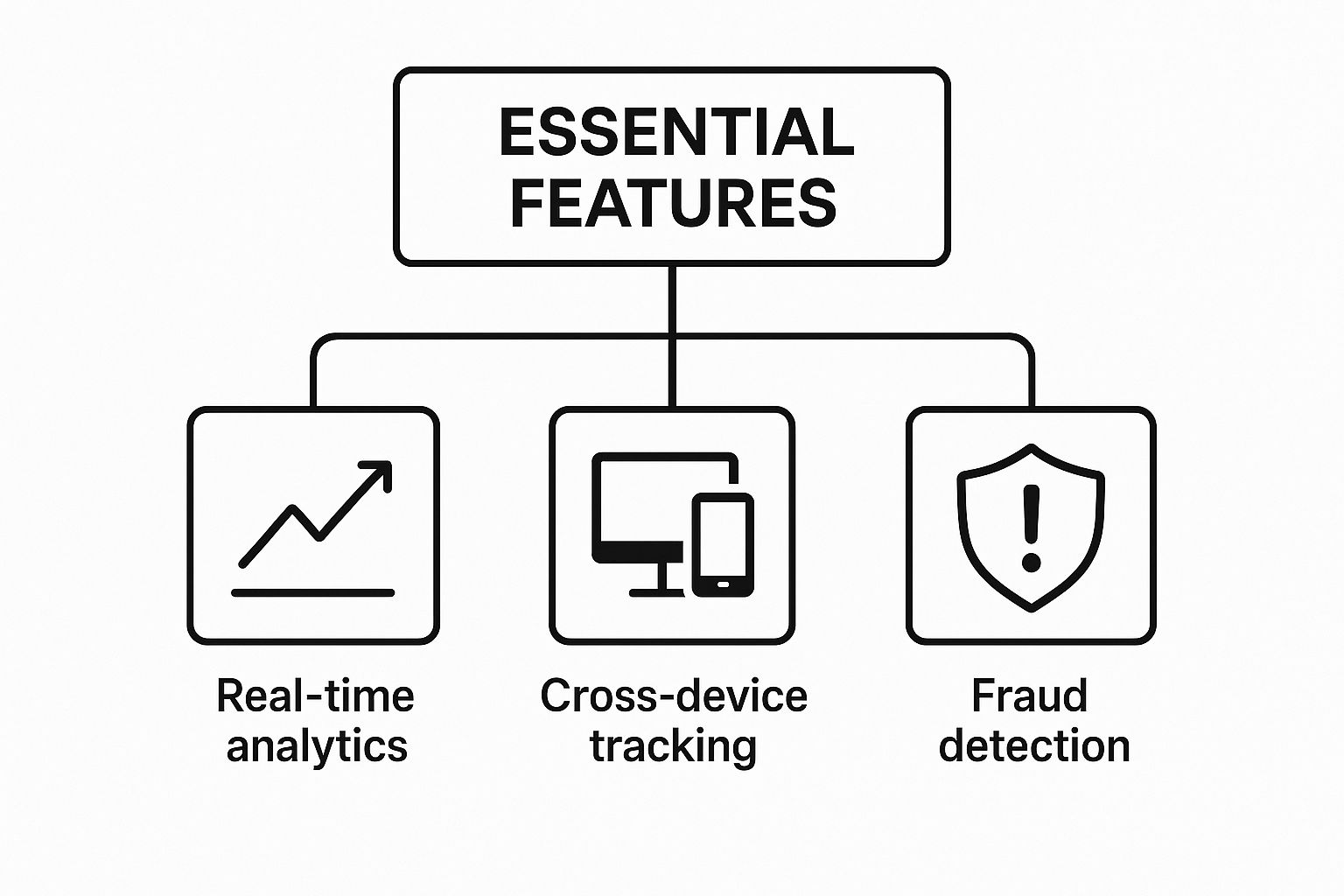
This shows how foundational elements like solid analytics and fraud detection work together to create a tracking environment you can actually trust.
To help you cut through the noise, here's a look at the features that should be at the very top of your list.
Must-Have Affiliate Tracking Software Features for Amazon Sellers
| Feature | Why It's Critical for Amazon Sellers |
|---|---|
| Real-Time Analytics | In e-commerce, yesterday's data is ancient history. You need to see performance as it happens to pivot quickly and capitalize on successful campaigns. |
| Cross-Device Tracking | Customers hop from phone to laptop. This feature ensures you correctly attribute sales and pay partners fairly, even when the purchase happens on a different device. |
| Customizable Commissions | A one-size-fits-all approach doesn't motivate partners. You need the flexibility to set different rates by product, partner performance, or promotional period. |
| Deep Linking & Attribution | Sending traffic to your Amazon storefront isn't enough. You must be able to track specific conversion events like 'Add to Cart' to understand true partner value. |
| Fraud Detection | Protects your budget from bad actors and ensures you're only paying for legitimate, high-quality traffic that leads to real sales. |
| Easy Partner Payouts | Complicated payment processes frustrate partners. A streamlined, automated payout system keeps your affiliates happy and focused on promoting your brand. |
These features aren't just "nice-to-haves"; they are the engine of a high-performing affiliate program on Amazon.
Real-Time Analytics and Reporting
In the world of Amazon, timing is everything. Data that's a week old is practically useless. You simply can't afford to wait to see if a partner's campaign is actually driving sales. That's why real-time analytics are a non-negotiable. They give you a live, up-to-the-minute view of performance.
This lets you make smart decisions on the fly, like shifting more budget to a high-performing influencer while their campaign is still running. A good dashboard will show you the metrics that matter most on Amazon:
- Clicks: The raw number of people engaging with your affiliate links.
- Add to Carts: A powerful signal of purchase intent generated by a partner's promotion.
- Conversion Rate: The bottom-line percentage of clicks that turn into actual sales.
- Total Sales: The direct revenue you can attribute to each and every affiliate.
This level of detail gets you way beyond vanity metrics. You see the entire journey, from the first click on a blog to the final purchase on Amazon. That clarity is what you need to optimize your marketing spend and get the best possible ROI.
Cross-Device Tracking Capabilities
The modern customer journey is messy. A shopper might see your product on an influencer's Instagram Story on their phone, look up reviews on their tablet, and finally make the purchase on their work computer. Without cross-device tracking, that sale would look like it came out of nowhere, and your affiliate would lose their well-earned commission.
This feature is absolutely crucial for attributing sales accurately and keeping your partners happy. It paints a complete picture of how customers are finding you. The technology is getting better all the time, too. In fact, adoption of cross-device tracking is expected to hit 70% by 2024, a big jump from just 53% in 2022. It's quickly becoming the new standard.
Customizable Commission Structures
Your partners aren't all the same, so why would you pay them the same? The best software gives you flexible and customizable commission rules. This isn't just about paying people; it's a powerful tool for motivating your partners and hitting specific business goals.
For example, you could easily set up rules to:
- Offer Tiered Commissions: Give your top performers a bump in their commission rate once they hit a certain sales target.
- Set Product-Specific Rates: Pay a higher commission on a new product you're launching or an item with a higher profit margin.
- Run Limited-Time Bonuses: Supercharge your promotions during Prime Day or Black Friday with a temporary commission increase.
This kind of flexibility transforms your commission plan from a simple expense into a strategic lever for growth. It helps you build stronger relationships with your best affiliates while driving the exact behavior you want. This pairs perfectly with the ability to create a custom Amazon deep link to send traffic exactly where you want it to go.
Key Takeaway: You're looking for more than just a simple link-tracker. You need a system that delivers real-time insights, understands how customers shop today, and gives you the tools to build a fair, motivating, and profitable partner program on Amazon.
Unlocking Key Benefits for Your Amazon Brand
Getting the right affiliate tracking software isn't just about making commission payouts easier. It's a game-changer for your business, giving you a crystal-clear picture of what's actually working in your partner marketing. Think of it like going from a blurry, out-of-focus photo of your marketing efforts to a sharp, high-definition video.

This new clarity lets you confidently double down on your best-performing affiliates. More importantly, it shows you exactly where you're wasting money. The real win is shifting your marketing budget based on hard sales data instead of fuzzy metrics like clicks or impressions.
Maximize Your Marketing ROI
Without solid tracking, you're essentially just throwing money at different channels—influencers, blogs, social media—and hoping for the best. It's like trying to fill a bucket with holes in it. Affiliate tracking software uses data to plug those holes for good.
Let's say you're working with two influencers. Influencer A brings in 10,000 clicks, but that only turns into 50 sales. Meanwhile, Influencer B gets just 3,000 clicks but drives a whopping 200 sales. Without tracking, you might reward Influencer A for all that traffic. With tracking, you know the truth: Influencer B is four times more effective and deserves a bigger piece of your budget.
By directly linking specific marketing campaigns to actual sales, affiliate software makes every dollar accountable. You're no longer guessing—you're making informed decisions that dramatically improve your return on investment (ROI).
This data-first approach is quickly becoming essential as the market gets more crowded. In fact, the affiliate marketing software market is expected to hit $9.8 billion by 2035, a huge jump driven by brands who need precise ways to measure results and get the most out of their partnerships.
Build Stronger Affiliate Relationships
Let's be honest: top-tier affiliates and creators are pros. They want to work with brands that are organized, transparent, and dependable. Fumbling around with messy spreadsheets and manual payments sends the wrong message—that you're not taking your own program seriously.
A dedicated software platform, on the other hand, shows you mean business. It builds trust and strengthens your partnerships by giving affiliates a professional dashboard with:
- Total Transparency: Affiliates can log in and see their clicks, conversions, and commissions in real-time. No more guessing games about how they're performing.
- Reliable Payments: Automated payouts mean your partners get paid correctly and on time, every time. This simple step keeps them motivated and happy.
- Actionable Data: They can see which of their promotional tactics are paying off, helping them fine-tune their strategy to drive more sales for you (and earn more for themselves).
This kind of professional setup transforms casual partners into true brand champions who are excited to promote your products for the long haul.
Achieve True Data Attribution
One of the toughest puzzles for any Amazon seller is figuring out which of your off-Amazon marketing efforts are actually ringing the register. Affiliate tracking software finally solves this by linking up with tools like Amazon Attribution, giving you a direct line of sight from a click to a sale.
Now you can finally get answers to those critical questions. "Did that TikTok campaign actually sell products, or did it just get a lot of views?" You can pinpoint exactly which partner's link led to a customer adding an item to their cart or making a purchase. For a deeper dive into how this works, you can learn more about Amazon Attribution and its benefits in our comprehensive guide. This level of attribution is the secret to scaling your brand profitably and making smarter marketing decisions, day in and day out.
How to Choose the Right Software for Your Business
With so many platforms on the market, picking the right affiliate tracking software can feel overwhelming. Every option promises the moon, but the best tool is simply the one that fits your brand’s specific needs, budget, and where you plan to go. Choose wrong, and you could end up with a costly subscription and a bunch of frustrated partners.
So, how do you make a confident decision? It starts with a simple evaluation framework. Think of it like buying a car—you wouldn’t just grab the flashiest one on the lot. You'd consider its size, mileage, and safety ratings to make sure it actually fits your life. We're going to apply that same practical thinking here.
This guide will walk you through the key questions to ask, helping you cut through the marketing noise and find a solution that genuinely works for your Amazon business.
Start with Your Brand’s Unique Needs
Before you dive into demos and sales pitches, the most important step is to look inward. The perfect software for a brand juggling 500 micro-influencers is worlds away from what a brand needs when starting out with just five key partners. Your current scale and future goals are what really dictate which features are must-haves and which are just noise.
Start by getting clear on these basics:
- How many affiliates will you manage? Are you starting small with a curated group, or do you plan on building a massive network right away?
- What’s your team’s tech-savviness? Do you need something that’s basically plug-and-play, or can your team handle a more technical setup?
- What’s your budget? Be real about what you can invest. Some platforms hit you with high upfront costs, while others offer more flexible pricing tied to performance.
Answering these questions first gives you a clear picture of what you’re looking for, making it way easier to weed out the tools that just aren’t a good fit.
Non-Negotiable: Flawless Amazon Integration
For any Amazon seller, this is the absolute deal-breaker. The affiliate tracking software you choose must have a seamless, native integration with the Amazon Attribution API. This isn’t just a nice-to-have feature; it’s the core engine that makes accurate tracking on Amazon even possible.
Without that direct link, the software can't reliably attribute your sales, track crucial metrics like "Add to Carts," or automate commissions based on real Amazon data. It’s like trying to navigate a new city without GPS—you’re just guessing.
When you talk to a vendor, your very first question should be: "How do you integrate with the Amazon Attribution API?" If they stumble or can't give you a straight, confident answer, they are not the right partner for your Amazon brand.
A Practical Software Selection Checklist
Once you’ve defined your needs and confirmed the Amazon integration, it’s time to get into the nitty-gritty. This checklist will help you evaluate and compare different software providers head-to-head. Use it to guide your conversations and make sure you don’t miss anything important.
Software Selection Checklist
| Evaluation Criteria | Question to Ask | Why It Matters |
|---|---|---|
| Pricing Model | Is it a flat monthly fee, a percentage of affiliate sales, or a tiered plan based on usage? Are there hidden setup fees? | The model must align with your budget and cash flow. A fee based on sales might be better for new programs, while a flat fee can be more cost-effective at scale. |
| Scalability | Can the platform grow with me? What happens if I want to add hundreds of new affiliates or track thousands of sales? | You need a solution that won’t hold you back. Ensure the software can handle your projected growth without significant price hikes or performance issues. |
| Reporting & Analytics | What specific Amazon metrics can I track? Can I see data like Add to Carts, conversion rates, and sales per affiliate? | You need deep, actionable insights to optimize your program. Generic reports are not enough; you need Amazon-specific data to make smart decisions. |
| Customer Support | What kind of support is offered? Is it email-only, or can I get help via phone or live chat? What are the typical response times? | When issues arise, you need timely and effective help. Good support can be the difference between a minor hiccup and a major program disruption. |
Armed with these questions, you can approach your search with a clear, focused strategy. For an even deeper dive, check out our complete guide on how to choose the right affiliate management software. This approach ensures you pick a tool that not only meets your needs today but is ready to support your brand’s growth for years to come.
Your Step-by-Step Implementation Guide
Picking the right affiliate tracking software is a big win, but the real work—and the real growth—starts when you set it up. A powerful tool is only as good as how you use it. This guide will give you a clear roadmap to get your affiliate program running smoothly, helping you build momentum from day one and avoid the common traps many sellers fall into.
Think of it like assembling a new piece of high-end furniture. You've got all the best parts, but if you toss the instructions, you'll end up with something wobbly and unreliable. A careful, step-by-step setup, on the other hand, creates a solid foundation you can build on for years.

Let's walk through the key stages, from the initial tech setup to bringing on your first partners and laying down the rules that will keep your program running strong.
Setting Up Your Tracking Foundation
First things first, you need to handle the technical side. It's the most critical step: connecting your new software to your Amazon account. This is done by integrating with the Amazon Attribution API, which is what lets your platform generate the special tracking links that make this whole system work. These links are like digital breadcrumbs, connecting a partner’s promotion directly to a sale in your store.
Without this connection, your software is essentially flying blind. You won't see which affiliates are driving sales, "Add to Carts," or any other key actions.
The setup process usually involves a few key moves:
- Authorize the Software: You’ll need to grant permission inside your Amazon Seller Central account for the platform to access your Attribution data.
- Configure Your Products: Next, you'll import your product catalog. This allows you to create specific tracking links for different items.
- Establish Basic Settings: This is where you set your currency, payout terms, and the cookie duration (the time window an affiliate has to get credit for a sale after someone clicks their link).
A common mistake is rushing this part. Take your time. Double-check that every connection is verified and every setting is correct. A small error here can turn into a massive data headache down the road.
Onboarding Your First Affiliate Partners
Once the technical backbone is in place, it’s time to bring your first partners on board. A smooth onboarding process sets a professional tone and gets your affiliates genuinely excited to start promoting your products. This is your best chance to make a great first impression and give them everything they need to succeed.
A solid onboarding experience should include:
- A Clear Welcome: Send a welcome email that explains how to log into their dashboard and, most importantly, where to find their unique tracking links.
- Providing Resources: Give them easy access to brand assets. Think logos, high-quality product images, and key talking points to make sure their promotions look and feel on-brand.
- Explaining the Rules: Clearly lay out your program's terms. This means commission rates, payout schedules, and any restrictions on how they can promote your products.
This initial communication is all about building trust. The more informed and supported your partners feel right from the start, the more motivated they'll be to drive sales for you.
Establishing Program Rules and Commissions
Every good affiliate program needs a clear set of rules to operate smoothly. This isn't about being restrictive—it’s about creating a fair, transparent environment where everyone knows what to expect. Your commission structure is the most important rule of all, as it’s the primary incentive for your partners.
Start with a simple, competitive commission rate. Down the line, your affiliate tracking software will let you create more sophisticated structures, like offering higher rates to your top performers or running bonus campaigns for new product launches.
Messy link management and unclear terms are two of the biggest reasons affiliate programs fail. To build something that lasts, you need a system that supports both you and your partners. For more in-depth strategies, check out our post on how to manage affiliates effectively for practical tips on nurturing these key relationships. By putting a solid structure in place from the beginning, you create a scalable program that attracts high-quality partners and drives real, sustainable growth for your Amazon brand.
Got Questions? We've Got Answers
Stepping into the world of affiliate tracking software can feel a little confusing at first, especially for Amazon sellers just starting to build their own partner programs. It's smart to get a clear picture before you commit your time and money. Here, we'll tackle the most common questions we hear from brands just like yours.
Our goal is to clear up any confusion so you can feel totally confident moving forward with a powerful, profitable affiliate program. Let's dive in.
Do I Really Need Amazon Brand Registry to Use This Software?
This is a big one, and the answer is a clear and simple "yes." For any affiliate tracking software to work its magic, it needs to plug into your account using the Amazon Attribution API. That API is the key, and it's only available to sellers enrolled in the Amazon Brand Registry program.
Without Brand Registry, you can't generate the special tracking links the software needs to measure performance accurately. Essentially, your software would be flying blind, unable to connect an affiliate's marketing efforts to an actual sale on Amazon.
So, if you're serious about building a real, data-driven partner program, getting into Brand Registry is your non-negotiable first step. It unlocks everything.
How Is This Different From The Amazon Associates Program?
It’s easy to mix these two up, but they are worlds apart. Think of it like renting a room in a giant hotel versus designing and building your own custom house.
Amazon Associates Program: This is Amazon's public, one-size-fits-all program. Amazon is in charge of everything—they find the affiliates, they set the commission rates (which are often tiny), and they handle payments. As a seller, you have zero control and almost no idea who is promoting your products.
Your Own Program (with Software): This is your private, hand-picked network of partners. You're in the driver's seat. You choose your affiliates, negotiate commission rates that make sense for your business, and get incredibly detailed analytics on how they're performing for your brand specifically.
The Amazon Associates Program is a massive, impersonal system. Building your own program with dedicated software lets you create genuine, high-value relationships tailored to your brand's unique mission and goals.
This control is what allows you to build powerful, long-term partnerships with creators who truly love your products, instead of just being another random item in Amazon's massive catalog.
Is Affiliate Tracking Software Too Expensive For a Small Brand?
That's a valid concern, but the good news is that things have changed. While some platforms are definitely built for enterprise-level companies with huge budgets, many modern tools are made with small and growing businesses in mind. The trick is to find one with flexible pricing.
Many platforms, including Coral, have tiered plans that grow with you. You'll often see options like:
- A free or low-cost starter tier that takes a small percentage of affiliate-driven sales.
- Affordable monthly plans that scale up as your program brings in more revenue.
- Pricing based on how many active partners you're working with.
More importantly, the investment pays for itself by showing you exactly what’s working and what isn't. You can quickly see which partners aren't performing, cut that wasted spend, and double down on the affiliates who are actually driving a positive ROI. For a small brand, that kind of efficiency is a game-changer for growth.
What Happens When a Customer Returns an Order?
This is a critical feature that protects your bottom line. Any good affiliate tracking software is built to handle returns and cancellations automatically, making sure you only pay commissions on sales that actually stick.
Here's a quick look at how it usually works:
- Pending Commission: An affiliate drives a sale, and the commission is logged but marked as "pending."
- Matching the Return Window: This pending period is timed to match Amazon's return window, which is typically 30 days.
- Automatic Sync & Adjustment: The software stays in sync with your Amazon sales data. If a customer returns the item within that window, the software automatically voids the commission. Poof, it's gone.
This automated "clawback" system gives you peace of mind. You never have to worry about paying for refunded sales, keeping your program's finances clean, accurate, and fair for both you and your partners.
Ready to build and scale your own high-performing affiliate program on Amazon? Coral provides the specialized tools you need to manage partners, track performance with precision, and drive sustainable growth. Start for free today.